If you're new to SEO, as you invest in your link building month after month, you probably expect to see a steady rise in your search rankings. However, the reality is often quite different. Instead of a linear progression, your site's rankings might dip, bounce around, or even occasionally vanish from the top 100 results altogether.
You may wonder if you're doing something wrong…
The Google Dance Explained
It's a common misconception that search rankings consistently improve with each new backlink. The reality is that even if you've flawlessly executed your SEO strategy, Google's algorithm may still cause your rankings to fluctuate.
The Google Dance is a distinct occurrence, setting itself apart from the typical ranking fluctuations experienced by every website. While it's normal for a site's search rankings to vary within a limited range of a few positions, the Google Dance is marked by seemingly random and wider-ranging fluctuations, with websites potentially vanishing from the top 100 search results for days at a time.
Google's Ranking documents patent (US8244722B1) describes a deliberate rank-transition process. A page can be moving towards a stronger ranking while its visible position initially moves in the opposite direction. The patent also explains how observing reactions to those changes can help identify ranking manipulation.
In Google's own words:
The rank of a document may initially decrease in response to a positive change in its link-based information. After a period of time, the document's rank might rise to its new steady state (target) value.
— Google Patent
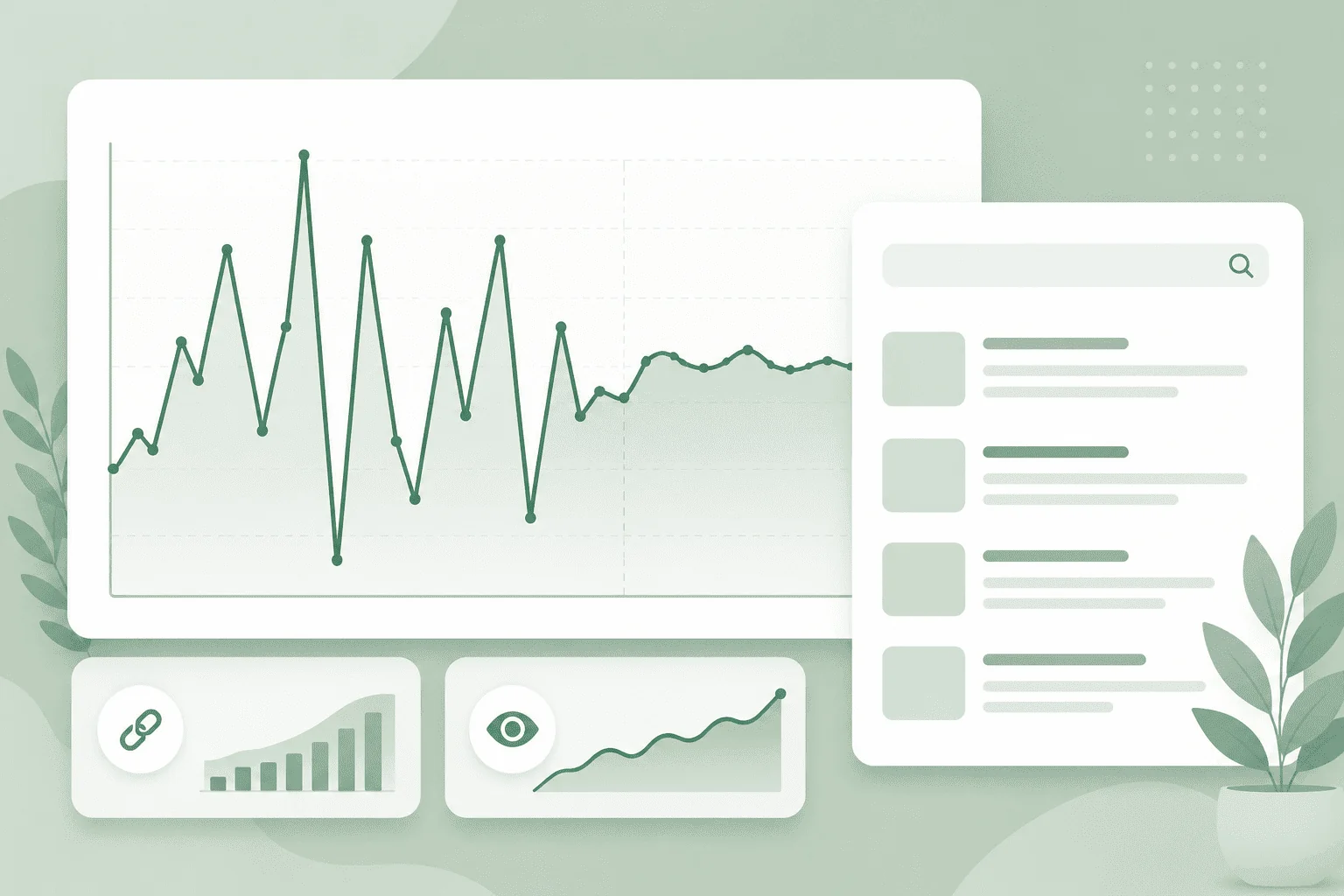
In other words, improvements to your backlink profile can be followed by a temporary ranking drop before the benefit becomes visible. Figure 7 illustrates precisely that pattern: an initial decline followed by a rise towards the new target rank.
A drop after new links go live does not automatically mean those links have harmed your site. This is the point of understanding the Google Dance. The patent gives a technical explanation for a pattern we have seen in campaign work, including the example below.

The ranking behaviour you see pictured above is not uncommon. This particular client was working in a very high competition niche. They were consistently building quality, authoritative links, regularly updating their website, and providing great value to their visitors. However, their rankings did not seem to be making much progress for around 6 months, despite all the third-party tools (Moz, Semrush, Ahrefs) reporting their authority increasing.
One morning, we found they had shot up 8 positions. A couple of days later they climbed to #3, and towards the end of the year they finally snagged the #1 position.
The Timeline and Implications of the Google Dance
The Google Dance is a dynamic process, with its duration ranging from just a few weeks to an entire year. However, it typically takes about 6-8 months for a page to settle into its true target value and reach its merited ranking position. During this phase of evaluation and recalibration, pinpointing the eventual standing of your page in the search rankings can be quite challenging.
During that period, track the work and its results together. Are relevant, authoritative sites linking to the right pages? Are those pages improving? Is visibility broadening across related searches? What is happening to qualified traffic and enquiries?
Moz's Domain and Page Authority and Ahrefs' Domain and URL Rating can help you follow changes in the backlink profile. Use these third-party indicators alongside Search Console and business outcomes to see progress that a single ranking chart can miss. Our SEO KPI guide explains how to put that report together.
Keep your campaign steady through the Google Dance
It's not unusual to feel disheartened when rankings drop after you have invested in improving them. The temptation is to stop, reverse recent work or change everything at once. That can interrupt a sound campaign before the longer-term result has emerged.
Keep a clear record of changes and check for concrete problems such as an accidental indexing block, a broken target page or a Search Console manual action. Those need action. Once those checks are clear, a temporary dip alone is a poor reason to abandon consistent, quality work.
Adopt a gradual approach to link building
If you have a website that hasn't engaged in any link-building activities, start slow, gradually increasing your efforts over the next 3-6 months.
The idea is to build links at a pace consistent with a naturally growing website.
That means: don't start and stop link building abruptly, waiting to "see what happens".
Follow a link building strategy for a set number of months and be consistent.
Focus on high-quality content
Create well-researched, engaging, and valuable content that provides useful information to your target audience. Give people a reason to visit, read and return. Strong destination pages also give each new placement more useful material to support.
Diversify your backlink profile
Aim for a mix of backlinks from different sources, including high-quality websites, social media platforms, and business profiles. This builds recognition across several places your audience uses and broadens the sources supporting your website.
Keep your website updated
Regularly update your website with fresh content, optimised meta tags, and improved site structure. Make sure the pages you are strengthening remain accurate, useful and easy for search engines to understand.
Leverage internal linking
Establish a strong internal linking structure to distribute link equity throughout your website. Connect supporting guides to priority service and product pages so readers and search engines can follow the relationships between them.
Optimise for user experience
Ensure your website is user-friendly, with fast load times, mobile responsiveness, and easy navigation. Help the visitors you earn find answers, explore your offer and take the next step.
Build a strong brand presence
Establish your brand across various online channels, including social media, forums, and industry-specific platforms. Familiarity and credible coverage give people more reasons to recognise and trust your business when they encounter it in search.
Engage with your audience
Interact with your target audience through blog comments, social media, and email marketing. Building a loyal following can help drive consistent traffic to your site, reducing the impact of ranking fluctuations caused by the Google Dance.
Be patient and consistent
It's essential to remain patient and consistent in your SEO efforts, especially during the Google Dance. Continue to focus on best practices and long-term strategies, rather than reacting impulsively to temporary ranking fluctuations.
Mastering the Google Dance: Tips for Success
Understanding the Google Dance helps you stay focused when good work has yet to show up in the rankings. Keep the original campaign objectives in view:
- Consistently monitor Domain and Page Authority, Domain and URL Rating, and visitor engagement metrics to gauge progress during the Google Dance.
- Adopt a gradual link-building strategy, starting slow and increasing your efforts over time.
- Keep producing and promoting high-quality, engaging content that provides value to your audience.
Our client's move from months of frustration to #3, then #1, is a memorable example of why we take that longer view. Stay patient, keep your campaign consistent, and judge progress across the wider set of indicators rather than one day's rankings.