Organic growth
Monthly organic visits rose from 7,000 to 25,000.
Case Study
Six months of flat organic growth and no AI search visibility. A 12-month authority campaign delivered top Google rankings and AI search citations.
Monthly organic visits rose from 7,000 to 25,000.
Tracked AI search prompts cited or referenced the brand 88% of the time.

Campaign Snapshot
Authority campaign run over a full year.
Contextual backlinks earned through monthly placements.
Average Moz Domain Authority across placements.
Monthly Google organic visits increased from 7,000 to 25,000.
Tracked AI answer prompts referenced the brand by Month 12.
Monthly organic conversions increased from 68 to 186.
The client is a mid-sized B2B provider of bespoke career development services. Their site was well designed, conversion-focused and technically optimised, but they relied mainly on referral partners and PPC before the campaign.
With organic growth flat for six months and no AI search visibility, the campaign was provisioned to lift organic sessions to the sales page by at least 200%, earn consistent AI answer-engine citations and generate more enterprise demo requests.
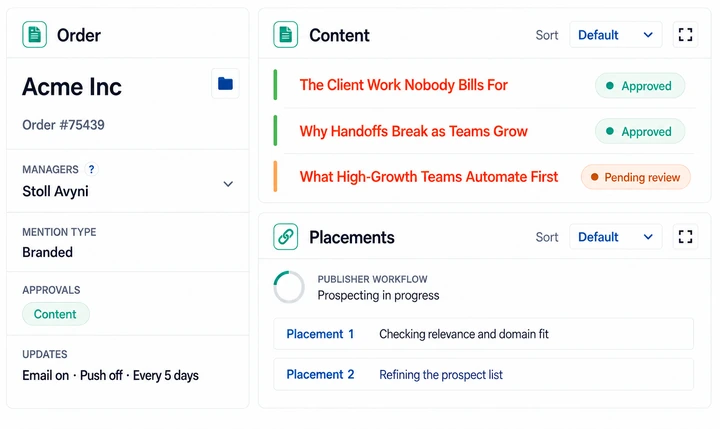
Rank Engine published 12 relevance-matched placements each month, featuring fresh industry insights and contextual brand mentions. High-authority sites with strong traffic and clean link profiles were prioritised, using a 30-day drip-feed schedule.
Research Foundation
Princeton's GEO research found that adding expert quotations, statistics and authoritative citations can materially improve AI-search visibility, with a reported 37% uplift on Perplexity.ai.
Ahrefs analysed one million US keyword SERPs and found referring-domain count still correlates with rankings, with a reported Spearman rho of about 0.255.
Search Engine Land reported that top-ranked pages acquire 5-14% more followed backlinks per month than lower-ranked pages, reinforcing consistent acquisition velocity.
Project Builder Setup
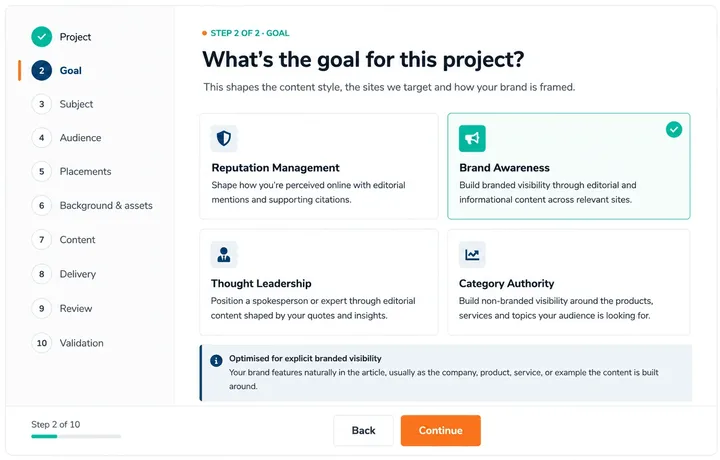
Rank Engine used the Project Builder to turn monthly campaign planning into one focused setup. Audience filters, content exclusions and Smart Select criteria kept research, content and site selection aligned with the client's positioning.
The brand was integrated as a real-world example within editorial and thought-leadership articles.
A slower cadence gave high-authority publishers time to accept and publish while Google discovered links week by week.
News, facts, statistics and quotes were focused around the client's area of operations.
Excluded contexts prevented brand confusion and kept mentions aligned with the client's market.
Relevance, traffic and authority were balanced to support rankings and visibility rather than a DA number alone.
Authoritative .com sites were balanced with niche .us placements where they supported relevance.
Content Production
The campaign needed useful editorial articles that could support organic rankings and give AI systems more credible third-party context.
Submitted topics were expanded with research, industry news and expert commentary.
Where topics were not supplied, Rank Engine identified angles from the client brief and current industry news.
Editorial drafts integrated case studies, data points, expert quotes and the client's core expertise.
Contextual backlinks, relevant imagery and external citations made each article credible and visually useful.
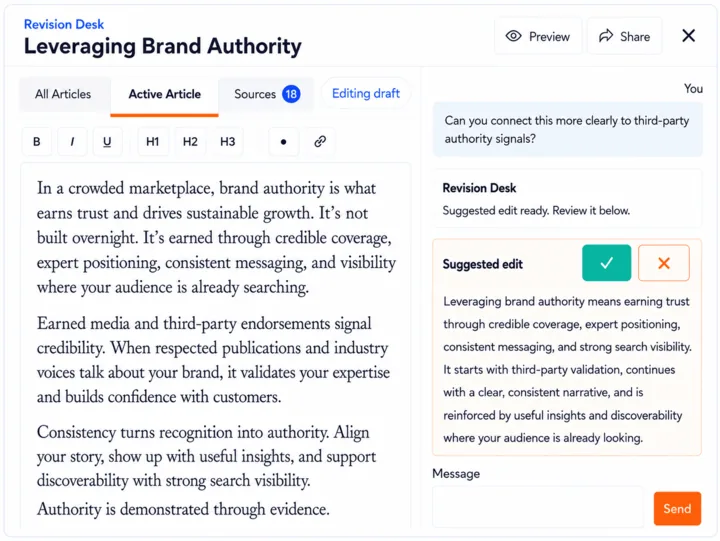
The team verified facts, polished tone and kept brand mentions genuine, not promotional.
Link building strategy
The campaign supported the whole site while concentrating stronger signals around the highest-value commercial pages.
Rank Engine targeted sites where career development, leadership and workplace content naturally belonged, so placements felt authentic to readers.
Branded homepage anchors established a natural link pattern and strengthened domain authority. More links were allocated to the primary service page based on keyword competition, with other target pages receiving proportional distribution.
Monthly process
AI agents researched industry sources and expert commentary, then drafts were proofread for facts, tone and message fit.
Smart Select scored sites for relevance, traffic, backlink health, authority and other ranking factors.
Content and placement approvals were available when oversight was required.
Each article was pitched as an insight-driven piece, with the drip-feed window supporting slower high-authority publishers.
Accepted articles published on approved, reputable sites with natural brand mentions and targeted anchor text.
Publisher prospects were filtered for career development, leadership and workplace relevance so brand mentions appeared in articles where the client naturally belonged.
The homepage received branded anchors to support domain authority. The primary service page received the heavier allocation, while secondary pages received proportional support to avoid over-optimisation.
Results
Baseline and Month 12 are monthly totals. Organic Traffic tracks Google Search visits. AI Citation Rate is the percentage of tracked AI search prompts where the brand was referenced. Conversions are monthly organic conversion actions.
Over 12 months, monthly organic traffic increased from 7,000 to 25,000 and monthly conversions rose from 68 to 186. AI visibility shifted from zero tracked citations to being referenced in 88% of tracked AI search prompts.
Key Takeaways
Strategic, relevance-led link building delivered a 257% traffic increase and secured Top 3 rankings for key product pages.
The brand moved from absent in AI-generated results to cited in 88% of tracked queries.
Conversions grew from 68 to 186 per month, proving the traffic was commercially useful.
Start a Campaign
Set the campaign direction and Rank Engine manages the placements that help your brand become easier to find, trust and recommend.